
Tree Leaning More After the Last Storm? How to Tell If It's Failing
October 22, 2026
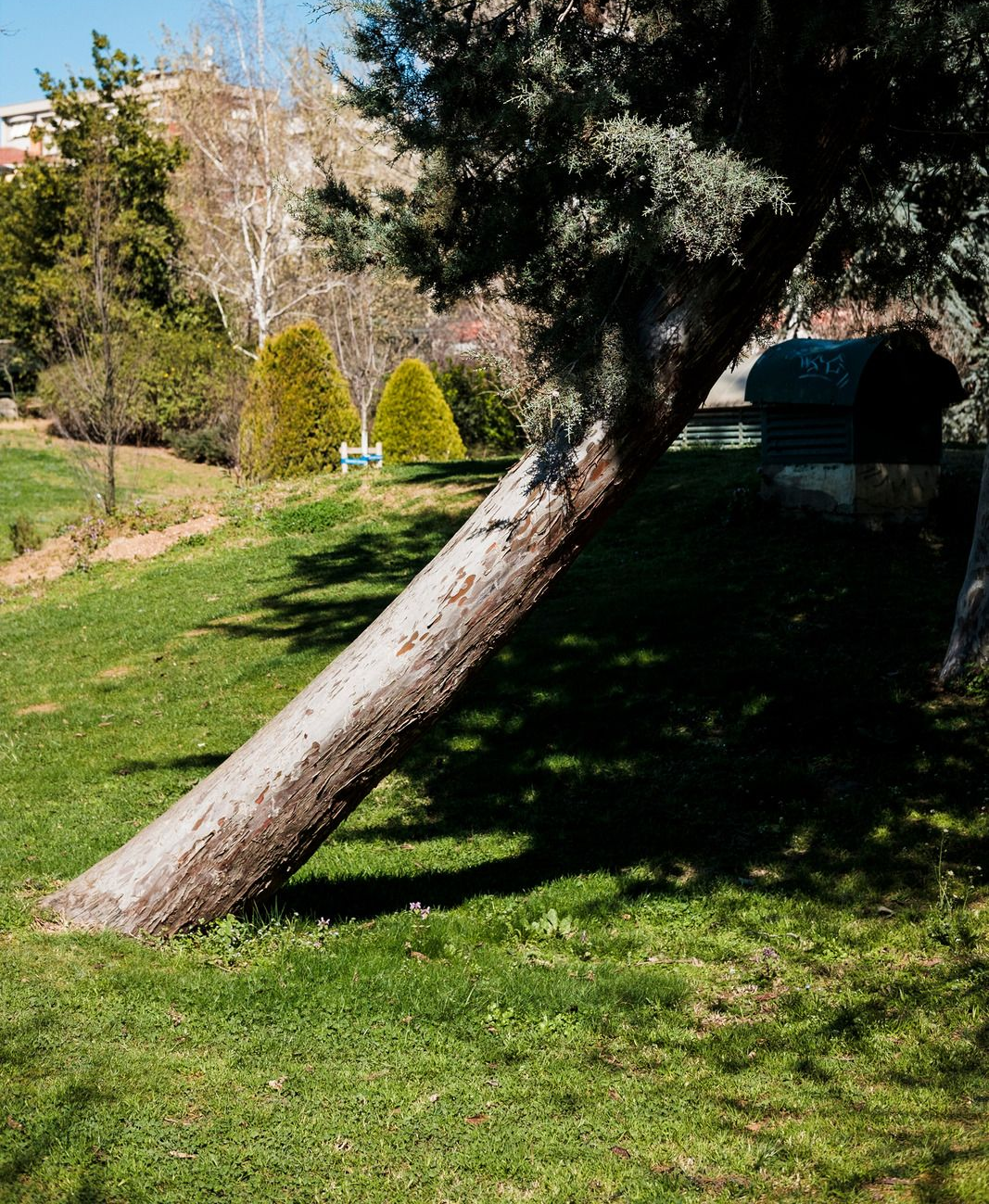
QUICK ANSWER: A tree that has leaned gently for years is usually adapting to light, but a lean that is new or increasing after a storm can mean the roots are letting go. The clearest warning signs are cracked or heaved soil on the side opposite the lean, a mound of lifted earth near the base, exposed or snapped roots, and a trunk that has visibly shifted against a fence, wall, or reference line. Wet ground and wind are the usual triggers. If any of those signs are present, keep people and vehicles away from the fall zone and have an arborist assess the tree before the next round of wind.
You walk out after the storm to check the yard, and something about the big tree by the fence looks different. It might be the same tree you have looked at for ten years, but the top seems to be pointing a little further toward the house than you remember. Maybe the fence line no longer lines up with the trunk the way it did. Maybe you just have a feeling.
That instinct is worth listening to. Plenty of trees lean and stay perfectly stable for decades, so a lean on its own is not an emergency. What matters is whether the lean is old or new, whether it is getting worse, and what the ground around the base is doing. Those three things tell an arborist far more than the angle of the trunk does.
Old Lean or New Lean: The Question That Matters Most
Trees grow toward light, and a tree that started life in the shade of a building or another tree often develops a curve or a steady tilt as it reaches. That kind of lean usually shows a few reliable traits. The trunk bends smoothly, the crown has grown to balance the tilt, and the roots on the lean side have built up thick buttressing over many years. The ground around the base looks undisturbed, and the lean has not changed in any way you can point to.
A failing lean looks different. It tends to be a straight tilt rather than a curve, with the trunk leaning as one stiff piece from the base. The crown may still sit squarely over the original root position, which means the whole tree is rotating out of the ground instead of growing into a new shape. And you will often find evidence at the soil line: fresh cracks, a raised ridge, or soil pulled away from the trunk on one side.
The simplest test is to compare against something fixed. Look at old photos, a fence post, the corner of a house, or a garden edging line that you know has not moved. If the trunk sits in a different place relative to those fixed points than it did before the storm, the tree has moved. A tree that has moved once can move again.
What the Roots Are Telling You
Most of a tree's anchoring comes from a wide, shallow mat of roots called the root plate. In a healthy tree, that plate extends well past the drip line of the canopy and holds the trunk upright the way a wide base holds a table. When a tree tilts after wind, the root plate on one side is typically pulling up while the roots on the other side are stretching or snapping.
That is why the ground gives you the earliest evidence. Look closely at the soil on the side of the tree opposite the lean. Cracks that run in an arc, soil that has risen into a low mound, or a gap opening between the trunk and the dirt all suggest the root plate has begun to lift. On the lean side, look for soil that has been pressed down or roots that have been crushed. Roots that are exposed, torn, or hanging in the air at the edge of a crack are another strong signal.
A few other root conditions raise the odds of failure even when the tilt looks small. Roots that were cut or damaged by past trenching, paving, or utility work are one. Girdling roots that wrap the trunk and weaken the base are another, as is decay or fungal growth at the root flare, where the trunk widens into the roots. Compacted soil that keeps roots shallow and limits how far they can spread belongs on the list too. Any of these can make a tree less able to resist wind, which is why the same storm can leave one tree untouched and tip the one next to it.
Why Sacramento Valley Storms Test Trees This Hard
Our region has a pattern that is especially tough on trees. Long, dry summers leave roots working hard in baked clay, and drought can reduce the amount of fine root growth a tree has to anchor itself. Then comes a heavy winter storm. Clay soil absorbs water slowly, then holds it, so the ground can stay soft and slick well after the rain ends.
Saturated soil loses much of its grip. Sacramento has seen how this plays out. A record setting October storm in 2021 dropped more than five inches of rain on downtown in a single day, ending a long dry stretch, with gusts topping 50 miles per hour. Local garden experts warned at the time that waterlogged soil and strong gusts could topple even big trees, and that anyone with a leaning tree should get it assessed. Trees that had been quietly coping with drought suddenly faced wet ground and wind in the same week.
Trees with dense leaf cover catch the most wind, and evergreens hold rain on their needles and gain weight. Trees standing alone, such as a lone valley oak in a front yard or a big shade tree on a corner lot, lack the shelter of neighbors and take the full force of a gust. If your tree fits any of those descriptions and has leaned more since the last storm, treat it with more caution, not less.
TIP: Take a photo of the tree from the same spot, with a fixed object like a fence post or house corner in the frame, right now and again after the next windy day. Also photograph any soil cracks with a coin or tape measure beside them for scale. A simple before and after record helps an arborist judge whether movement is ongoing.
Other Warning Signs to Check While You Are Out There
Roots are only part of the picture. A tree can fail because the trunk or the canopy has a problem, and a lean often makes those problems worse. While you are looking at the base, scan the rest of the tree for other trouble. Cracks or splits in the trunk, especially at a fork where two stems meet, deserve attention. So do mushrooms or shelf like growths on the trunk or near the base, which often point to internal decay. Large dead branches, hanging limbs, or branches caught in the crown matter as well, along with bark that is loose, missing, or peeling away from the wood. A crown that has become noticeably lopsided, with most of the weight on the lean side, is another flag, as is sudden thinning or browning of leaves on a tree that looked healthy last season.
A tree with decay inside can look solid from the street and still be weak. Hollow or soft wood cannot carry the load that sound wood can, so a lean on a decayed trunk is a more serious combination than the same lean on a healthy one. This is one reason a visual check from the ground is a starting point and not a verdict.
Where the Tree Could Land Changes the Urgency
Not every leaning tree carries the same level of risk. Arborists think about risk as a combination of how likely the tree is to fail and what is in the path if it does. A leaning tree in the middle of an empty field is a very different situation from a leaning tree whose crown points at a bedroom, a driveway, a play area, or a power line.
Walk the area the tree would cover if it fell, which is usually a circle at least as wide as the tree is tall, and note what is inside it. Houses, garages, fences, parked cars, sheds, and patios all count. So do places where people regularly sit or walk. If the lean points toward any of those, and especially if the lean is new, the tree deserves a prompt look rather than a wait and see approach.
WARNING: Do not try to straighten, pull, or prop up a leaning tree yourself with ropes, vehicles, or posts, and do not cut into a tree that has shifted. A tree under that kind of tension can move suddenly and with great force. Keep children, pets, and vehicles out of the area beneath the lean until a professional has looked at it.
What an Arborist Looks At
A proper assessment goes well beyond eyeballing the angle. An arborist will start by learning the tree's history, including when the lean was first noticed and what the weather and soil conditions have been. Then they work through the tree from the ground up, looking at the root flare, the soil for cracks and movement, the trunk for decay and cavities, the union points where branches attach, and the shape and weight distribution of the crown.
They also consider the species and the site. Oaks, sycamores, pines, and other common Valley trees each have their own strengths and weak points, and a tree growing in compacted clay beside a paved driveway has a very different root environment than one in open lawn. The goal is to separate trees that are stable and need nothing, trees that can be made safer, and trees that are no longer safe to keep.
What Happens Next: Your Realistic Options
Once the picture is clear, the options usually fall into a few groups. If the tree has an old, stable lean and the roots and trunk are sound, the answer may be to leave it alone and check it periodically. If the tree is sound but carries too much weight on the lean side, selective pruning to reduce the load and balance the crown can lower the risk. For mature trees with a weak union or a structural flaw that is not yet failing, support systems such as cabling and bracing may help hold the tree together when it is a good candidate.
When the root plate has lifted, the trunk is hollow or badly decayed, or the tree is clearly moving, removal is often the safest choice, particularly if there is a target underneath. A tree with a partly lifted root plate cannot be reliably pushed back into place, because the roots that held it have already been broken. Waiting does not repair them. In those cases, a planned removal on your schedule is far better than an emergency removal after the tree has come down on something.
Whatever the recommendation is, ask the arborist to explain which signs led to it. A good assessment names the specific problem, such as a cracked root plate or a decayed base, so you can see why the decision makes sense.
Frequently Asked Questions
Is it normal for a tree to lean?
Yes. Many trees grow at an angle toward light or away from wind, and a long standing lean with a balanced crown and undisturbed soil is often stable. A new or worsening lean is the concern.
How can I tell if my tree is leaning more than before?
Compare the trunk against a fixed reference such as a fence post, a house corner, or an old photo. Cracks or a raised mound of soil near the base also suggest recent movement.
Can a leaning tree be straightened?
Young trees with small root balls can sometimes be re staked and guided upright. A mature tree that tilted after a storm generally cannot be pulled straight, since forcing it breaks more roots and reduces stability.
Should I stay away from a tree that leaned after a storm?
Yes, until it has been checked. Keep people, pets, and vehicles out of the area the tree could fall into, and avoid walking around the base while the soil is still saturated.
Does a leaning tree always need to be removed?
No. Some can be monitored, pruned to reduce weight, or supported. Removal makes the most sense when the root plate has lifted, the trunk has serious decay, or the tree is moving toward a target.
Can the soil being wet cause a tree to lean?
Yes. Saturated clay soil holds roots much more loosely, so wind a tree would normally shrug off can tilt or topple it. That is why leaning often shows up right after a rainy, windy storm.
Read The Base Before The Next Storm
A tree that has shifted once will not grow stronger on its own, and the next wind event is rarely announced in advance. The angle of the trunk tells you far less than the ground around it, so look at the soil on the side opposite the lean, check for a lifted mound or an arc of fresh cracks, and compare the trunk against a fence post or an old photo. A new or increasing lean is the signal that deserves a closer look.
Tree Tech Services
has spent 35
years reading
leaning trees
across Sacramento, CA, where dry summers and saturated winter clay set up the exact conditions that loosen a root plate. Examining the root flare, the soil, and the trunk together is what separates a stable old lean from a tree that is quietly rotating out of the ground. Catching the difference early keeps a planned decision on your schedule rather than an emergency after the tree has already come down on something.