
Mushrooms or Conks on Your Tree Trunk? What Fungus Signals Inside
September 30, 2026
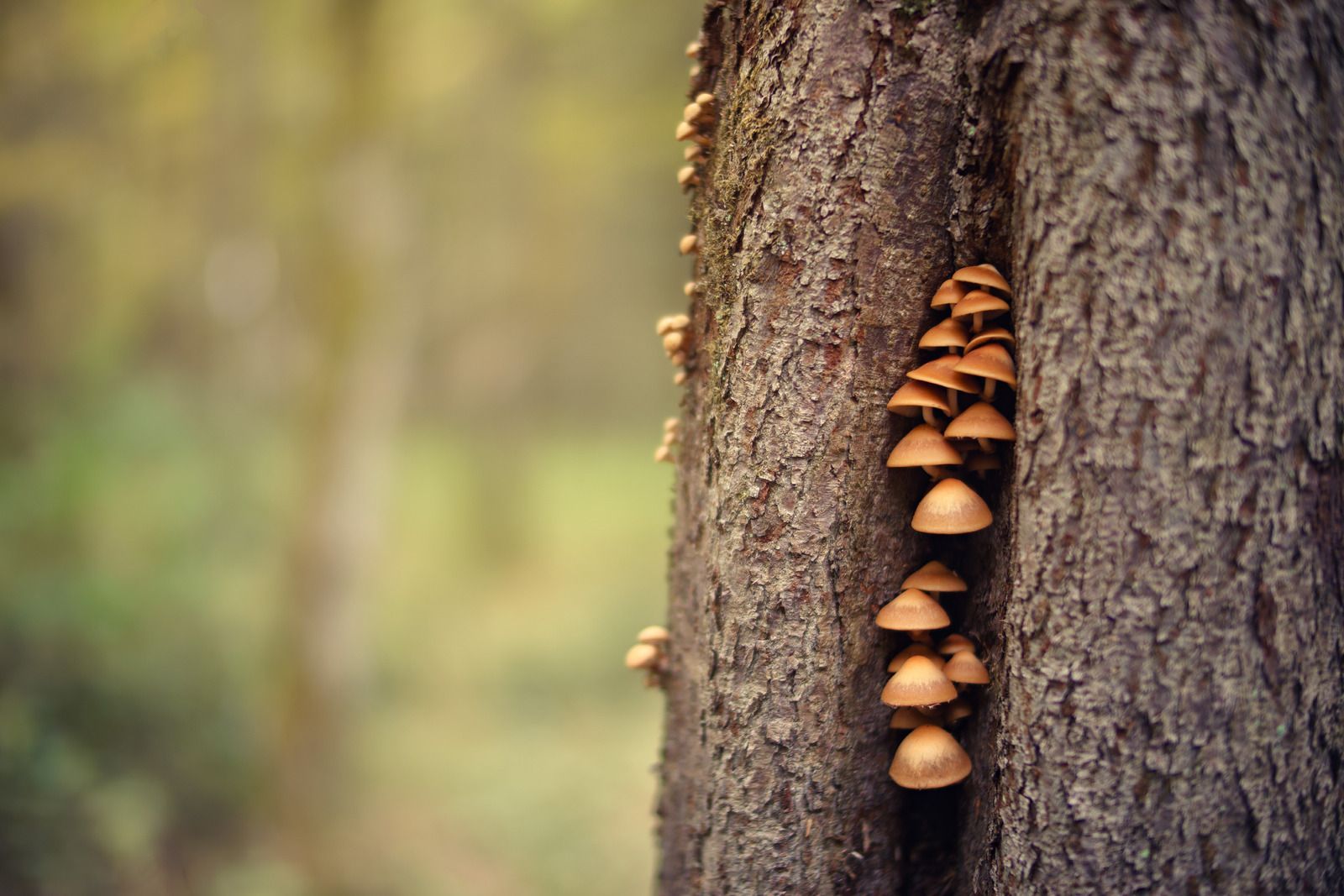
QUICK ANSWER: A mushroom, shelf, or conk growing on a tree trunk is a fruiting body, and it almost never shows up until the fungus underneath has already been breaking down wood for months or years. The growth itself isn't the problem. It's a visible clue pointing at internal decay you can't see, and the type of fungus, its color, shape, and location on the trunk all say something different about how much wood strength has already been lost. Some fungi cause a slow, contained rot; others move fast and hollow out a trunk from the inside while the bark and canopy still look green. Because the real damage is hidden, a hands-on inspection is the only way to know if the tree in front of you needs monitoring or is already a structural risk.
You noticed it on a Saturday morning, probably while dragging the hose past the valley oak in the side yard. A shelf-shaped growth, maybe the size of a dinner plate, jutting out of the bark near the base. Or a cluster of small tan mushrooms pushing up through the mulch right where the trunk meets the ground. Your first instinct is to knock it off and move on with your day. Don't. That growth is the only part of the fungus you can actually see, and by the time it shows up on the outside, the organism has usually been working through the wood for a while already.
Sacramento's oaks, sweetgums, and valley trees deal with a particular set of stresses that make this scenario common. Long, dry summers stretch trees thin on moisture. Compacted clay soil around foundations and driveways restricts root growth. Old pruning wounds, sunscald, and storm-snapped limbs all leave openings that spores drift into on the wind. Put those factors together over a decade or two, and a fungus that's been quietly feeding on the heartwood finally sends up a fruiting body to release its spores. That's the mushroom you found by the hose.
What You're Actually Looking At
Mushrooms, brackets, and conks share the same basic structure but come in different shapes. A mushroom has a cap and stem and usually grows from soil or root tissue at the base of the trunk. A bracket or conk grows directly out of the bark, shelf-style, with no stem at all, and it can be soft and fleshy or hard as a hoof depending on the species and its age. None of them are the fungus itself — they're the reproductive organ. The actual organism is a network of thread-like filaments called mycelium, and it's already spread through the wood tissue around and beyond wherever that fruiting body poked through.
Here's the part most homeowners get wrong: knocking off the mushroom or spraying the trunk doesn't touch the mycelium underneath. It stops spores from spreading to other trees, and that's worth doing, but the decay keeps going whether the visible growth is there or not.
Why the Growth Means Decay Started Long Ago
Wood decay fungi break down the cellulose, lignin, or both, inside a tree's cell walls, and they do it slowly enough that a tree can carry the infection for years without dropping a single leaf out of season. Research on shade and yard trees has found that a loss of just 10% of a section's wood weight to decay fungi can translate into a 70 to 90% loss in wood strength. That gap between how a tree looks and how much load it can actually bear is exactly why a branch that appears sound sometimes fails on a calm day.
Location matters just as much as the type of fungus. A conk near the root flare can signal decay running well up into the trunk, and depending on the species, the rotted column of wood can extend ten to fifteen feet above or below where the fruiting body is actually growing. Some fungi, like the ones responsible for chicken-of-the-woods, don't even produce a visible conk until the internal damage is already extensive — by the time you see color on the bark, the fungus has usually had years to work.
White Rot, Brown Rot, and Why the Difference Matters
Not all decay behaves the same way, and the type tells an arborist a lot about what kind of failure to expect. White rot fungi break down both lignin and cellulose, leaving wood that feels soft, spongy, or stringy — this is the more common pattern in broadleaf trees like oaks and maples, and it tends to make a limb bend and tear rather than snap cleanly. Brown rot fungi target mainly the cellulose and hemicellulose, leaving the brownish lignin behind, and the resulting wood dries out, cracks into small cube-shaped chunks, and becomes brittle. A brown-rotted limb is more likely to break suddenly, with little warning, than a white-rotted one. Soft rot, caused by fungi and bacteria working together right at the site of infection, spreads more slowly than either but can still hollow out a trunk given enough time.
None of this is something you can diagnose by eye from the ground. It takes cutting into a sample or, more often, reading the species of fungus itself, since most wood decay fungi are fairly consistent about which type of rot they cause.
Fungi Sacramento Valley Trees Commonly Deal With
Oaks around the valley are frequent hosts for a handful of well-documented decay fungi. Armillaria, sometimes called oak root fungus, produces honey-colored mushrooms at the base of infected trees after the first real rains of the season, and underneath the bark it leaves white, fan-shaped mats along with dark, shoestring-like strands that spread the infection through root contact with neighboring trees. Chicken-of-the-woods shows up as bright orange-and-yellow shelf clusters, often mid-trunk or up in a wound, and it causes a brown rot that leaves the interior wood dry and crumbly. Artist's conk forms hard, woody, tan-to-brown shelves low on the trunk and adds a new layer every year, which means a large one has likely been feeding on that tree for a long time. Each of these favors trees already under stress — the drought years, the compacted root zones near driveways, and the heat-scorched bark that shows up after a run of 100-degree days all make infection more likely.
A tree can carry one of these fungi for a surprisingly long stretch and still leaf out normally every spring. That's the frustrating part. The canopy is often the last thing to show trouble.
Bark cracks, old cavities, and healed-over wounds deserve a second look too. If you see a fruiting body anywhere near an old pruning cut, a lightning scar, or a spot where a limb tore away in a windstorm, treat that location as the likely entry point and check the surrounding trunk for cracks, oozing, or soft bark.
TIP: Leave the fruiting body in place if you're waiting on an inspection rather than scraping it off. Photograph it from a few angles and note exactly where it's growing on the trunk — height, side of the tree, distance from the root flare. That detail helps an arborist judge how far the decay column likely runs before they even touch a tool to the bark.
What a Real Inspection Involves
Because decay hides behind healthy-looking bark, a visual scan from the driveway only tells part of the story. A proper structural assessment starts with a close look at the fruiting body itself to identify the species, since that alone narrows down the likely rot pattern and risk level. From there, an arborist checks the trunk and major limbs for cracks, included bark, cavities, and soft spots by sounding the wood — tapping it and listening for the dull, hollow response that indicates a void versus the sharp, solid sound of intact wood. For trees near a house, driveway, or anywhere people gather underneath, a resistance drill or sonic tomography can map the extent of internal decay without cutting the tree open, giving a much clearer picture than a hammer test alone.
That combination of species identification, sounding, and, when warranted, instrumented testing is what separates a real risk assessment from a guess. It's also the only way to answer the question every homeowner actually wants answered: does this tree need to come down, or can it be monitored and managed for another few years.
WARNING: Not every dangerous decay fungus gives a clean hollow sound on a tap test. Certain canker and root rot fungi produce almost no aboveground symptoms and can leave a trunk sounding fairly solid even with significant internal loss, particularly low on the trunk near the root flare. A trunk that sounds okay under a hammer isn't automatically safe — that's exactly why identifying the species matters as much as the tap test itself.
Whatever the growth turns out to be, removing dead or dying limbs and correcting drainage or compaction issues around the root zone can slow the spread in a tree that's still structurally sound enough to keep. A tree with extensive decay near a major scaffold limb or low on the trunk, especially one close to a structure, is a different conversation entirely, and it's one worth having with a professional rather than guessing from the yard.
Frequently Asked Questions
Should I remove mushrooms growing at the base of my tree myself?
You can knock off the fruiting body to limit spore spread, but it won't stop the decay inside. Photograph and document the growth first, since it helps an arborist identify the species.
Does every tree with a conk or mushroom need to be removed?
No. Some fungi cause slow, contained decay a healthy tree carries for years with monitoring. Others hollow the trunk near a scaffold limb or root flare, creating risk that calls for removal.
Can a tree still be structurally safe if it has fungus growing on it?
It depends on how much of the cross-section is affected and where. A small conk on solid wood may pose little risk, but the same growth on a leaning trunk changes everything.
Why does fungus tend to show up after a hot, dry Sacramento summer?
Drought stress weakens a tree's defenses and cracks bark, giving spores an opening. Triple-digit days followed by fall rain often trigger fruiting bodies, since the fungus was already established and just needed moisture.
Is it normal for a tree to look completely healthy but still have serious internal decay?
Yes, and it's unsettling. Canopy foliage draws on outer sapwood, not the older heartwood where most decay fungi operate, so a tree leafs out fully while its trunk is compromised underneath.
Reading the Signs Before Your Tree Fails
A mushroom or conk on your trunk is rarely the whole story. It's a signal that something has been reshaping the wood beneath the bark long before the growth ever appeared. Reading that signal correctly means paying attention to the species, its position on the trunk, and how it relates to old wounds or the root flare. The visible growth is small, but the questions it raises about the tree's internal strength are the ones worth taking seriously.
Trees across the Sacramento Valley carry these infections quietly, often looking healthy right up until a limb lets go. That gap between how a tree appears and how much load it can actually bear is why a trained eye matters more than a hopeful guess. Tree Tech Services
has spent 35
years reading Sacramento, CA oaks and stressed yard trees, learning how far a decay column tends to run behind a single conk. Understanding when to watch and when to act keeps small clues from turning into sudden failures.